
Protected: How To Add A Contact To Elev8.One
What is the melting point of borosilicate?
See our Blog on Terms and Techniques
The softening pointis 820 °C ( 1,510 °F )
What is the most common paper used to make rolling papers?
Wood pulp rolling papers are the most popular papers, and this has been true for more than a century. They can even be blended with other fibres, and their texture makes them easy to handle.
Learn more about papers on our blog
| Brand | Origin | Fiber | Size (mm) | Weight | Burn |
|---|---|---|---|---|---|
| Abadie | France | Rice | 70×38 | Medium | Normal |
| American Spirit | Belgium | Flax | 77×44 | Med-Fine | Normal |
| Athey (Tube) | Philippines | – | 76×28 | Standard | Free |
| Bambu | Spain | Rice | 78×45 | Fine | Normal |
| Black Death | EU | Rice | 68×37 | Med-Fine | Normal |
| Club Carre (Modiano) | Italy | Rice | 70×44 | Very Fine | Normal |
| DLX | Spain | Rice/Hemp/Flax | 84×45 | Ultra-Fine | Med-Slow |
| Gizeh Green | Austria | Rice/Wood | 68×35 | Medium | Normal |
| Gizeh Green Extra Slim | Austria | Wood | 70×28 | Medium | Normal |
| Gizeh Hanf | Austria | Hemp | 68×35 | Standard | Normal |
| Gizeh Silver Tip | Austria | Rice | 68×35 | Ultra-Fine | Med-Slow |
| Gizeh Silver Extra Slim | Austria | Rice | 70×28 | Ultra-Fine | Normal |
| Gizeh Sphinx | Austria | Rice/Hemp | 68×35 | Fine | Med-Slow |
| JOB | France | Rice/Wood | 68×36 | Med-Standard | Normal |
| Joker 1¼ | Belgium | Wood | 78×45 | Fine | Med-Slow |
| Laramie Blue | EU | Rice/Wood | 69×37 | Medium | Free |
| OCB | France | Flax | 68×35 | Medium | Med-Slow |
| Peter Stokkebye | EU | Rice/Wood | 70×36 | Med-Standard | Normal |
| RAW Natural | Spain | Rice | 70×37 | Ultra-Fine | Normal |
| RIZLA+ Blue | France | Rice | 70×36 | Fine | Slow |
| RIZLA+ LLF | USA | Rice | 72×40 | Fine | Normal |
| Samson | EU | – | 68×35 | Medium | Normal |
| Smoking Corn | Spain | Corn | 78×45 | Med-Fine | Normal |
| Smoking Green | Spain | Hemp | 78×45 | Med-Fine | Normal |
| Smoking Orange | Spain | Rice/Wood | 70×37 | Med-Fine | Free |
| Swan 1¼ | South China | Flax | 79×43 | Fine | Normal |
| Top | France | Flax | 70×40 | Standard | Normal |
| Twister | Austria | Rice/Wood | 68×35 | Standard | Normal |
| Urban Wraps | Spain | Hemp | 79×45 | Ultra Fine | Slow |
| Wheat Straw LA+ | USA | Wheat | 72×39 | Fine | Free |
| Zig-Zag Kutkorners | France | Wood/Flax | 68×37 | Fine | Normal |
| Zig-Zag Orange | France | Wood/Flax | 78×45 | Med-Fine | Normal |
| Zig-Zag Unfolded | France | Wood/Flax | 68×36 | Medium | Normal |
Is a broken downstem in a bubbler pipe (hammer or saxophone style) repairable?
Yes and no.
It all depends on how it breaks. If there are cracks spreading out, more than likely it will end up cracking apart.
Yes if it is a clean break. These do take longer as the bowl has to be reworked and re blown and re pushed. It can be a long process, but it can be done without talented blowers.
Repairs cost $100 an hour with a $60 minimum charge
How do you smoke a chillum “sadhu style?”
This is neat. A chillum is not a bat but is always called a bat and we feel this is not proper. A true chillum to us is one that has the mouthpiece hole on the side. You then hold it in your hand and inhale through your hand without putting your lips on the pipe.
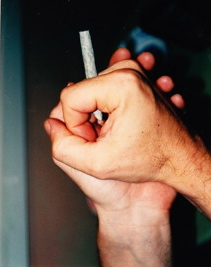

WHAT IS A CHILLUM: A LITTLE HISTORY
The chillum is a straight conical smoking pipe of unknown origin, traditionally used for smoking cannabis and opium. Although no one is completely certain who used them first, their earliest use dates back to the 18th century, where they were used by the holy men of India (Sadhus) and Hindu Monks from the Himalayan region. In fact, the loved phrase “boom Shankar” comes from the use of a chillum, where holy men would raise the pipe to their forehead upon lighting it, to invite Shiva and the other Gods to come and enjoy the pleasure of their bountiful hash with them.
Is all wig wag made from vac stack tubing? Are there other ways to prep for wig wag?
Yes. Wig wags are made from line tubing which can be made a few ways.
Vac Stack
When the crew pulls big glass at the studio they use this method. When they pull it this way they use an 80mm x 9mm outer tubing with 26 lines of color around a 45mm x 5mm tubing. This allows the glass to be pulled thinner making the colored tube more stable. You must know how to do a good termination in order for this method to make a dope wig wag.
Stick Stack
This is when rods of color are usually wrapped around a graphite rod and then inserted into a tube of clear. This will allow the color to be a bit more dense, as well as it makes it easier for a blower to do a termination.
This technique gets the same result as the Stick Stack but can be done on a smaller scale. Many lines can be done inside the tube-like this as it is drawn in like inside out glass.
Can any joint size be blown onto any size piece? (i.e. a 19mm joint on a mini rig, or a 10mm joint on a 2ft waterpipe)
Yes, the joint size is usually chosen by the blower for the size of the rig. A 19mm female would look crazy on a 3 inch tall dab rig. We find the 14mm to be the best overall size for the industry. Not too big, not too small.
What’s the difference between cheap and expensive butane?
Any butane from Europe will cost more than butane from Korea or China.
How much something is filtered is usually what says how much it will cost. But we have talked with butane manufacturers overseas and they will put whatever filtration the buyer wants. So we do not believe that there is much of a difference in butane quality.
The smell in butane is NOT butane, but rather an additive called Ethanethiol
We do feel however that European and American butane is cleaner than any other.
What’s the difference between 18mm and 19mm glass joints?
they are the same. People that do not understand how rounding works in math will call the 18.8 18. This is not right. 18.8 should round to 19, and this is how the two numbers get used in the industry.
Learn about how to measure your joint in our blog