What is an easy way to consume duff/AVB?

One great way is to just eat it with or without anything.  We like it as a topping.  To see more about this visit Cannabis Cooking With Jonny Duff.

Sprinkle on some peanut butter and bread

Salad topping

Sprinkle on your steak

Try a firecracker. Firecrackers are very simple and easy to make. You can use any cracker of your choice and a scoop of peanut butter with a pinch of duff on top. This is one easy way but there are endless options.

What is the fallback tax?

The Fallback tax rate is generated by BigCommerce and is the result of an error during tax calculation using AvaTax

Nothing is wrong when this happens.

Is there a brand of thermal bangers that work better than the rest? Ex: Is AFM’s thermal banger better than Whitney Harmon?

This all comes down to preference in our opinion.  Heating the banger has more effect on the flavor or harshness of the dab compared to the banger design.  The basic idea of a banger is conduction vaporization.  The heat needs to be enough to vaporizer the oils, but not so hot that it also vaporizes the fats and lipids.

What we have found is no raw quartz is made in the USA, but is assembled to make the American Banger.  This is just what it is as on a global level the USA can not make quartz cheap enough to compete with other countries at this time.

We feel the best banger is an e-nail like the Silver Surfer with the Quartz dab dish.

Learn more about conduction and convection vaporization.

Do you recommend one big terp pearl or two smaller ones?

This all comes down to what do you want to play with?  The balls move the oils around.  One should be enough if you do not have a good carb cap.  With a good directional carb cap you can get away with having terp perls.  But a terp Perl is fun to play with and also does help move the oils.  They even hold more heat as they increase the thermal mass


See Terp Pearls here

When was the first pipe made?

The origins of the tobacco pipe

They are still somewhat a mystery, despite their presence across all continents for thousands of years. It seems as though nobody can accurately date the first appearances of the pipe.

The first tobacco pipes found in Europe, from around 500 BC, were made of wooden stems or reed. Nomadic Indo-Europeans, the Scythians, used them to inhale the smoke from campfires. In turn, Greeks and Romans adopted the tobacco pipe, as well as Germanic peoples and Celtic tribes, who used them to smoke all sorts of herbs, and particularly the leaves from linden trees.

Tobacco as we know it today, and the culture that surrounds it, come from America. Over 500 years ago, American-Indians cultivated this plant as a medicinal treatment, but also to smoke it. They rolled up tobacco leaves in the shape of a large cigar that they called ‘tabaco’. They burned these tobacco leaves, along with the other herbs, in their famous tobacco pipe, which we now know as the ‘calumet’.
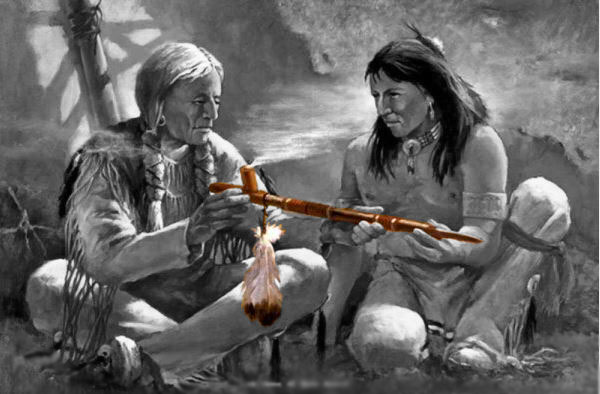
 

calumet


The tobacco plant still didn’t exist in Europe. It was in 1492 that Christopher Columbus discovered the plant on his expedition in America. He reported it upon his return to Europe, and shortly afterwards, the first manufacturing of tobacco pipes was registered.

The first manufactured tobacco pipes were made of clay, and mostly came from Northern Europe, at around the end of the sixteenth century. It was at the beginning of the seventeenth century when William Baernelts moved from his native England to Holland, to launch the first mass production of clay pipes. Despite starting out slowly, production then expanded to England and the south of France. After the Thirty Years’ War in France (1618-1648), the first clay pipes were made in Dunkirk and Dieppe, replicating the Dutch design. Due to its free port status, Dunkirk played a key role in receiving tobacco from North America, and distributing it across the territory. Saint Malo adopted the English technique. These two production techniques expanded across the rest of France, and other manufacturers were established in Saint Omer, Rouen, Rennes, Marseilles, and plenty of other locations.
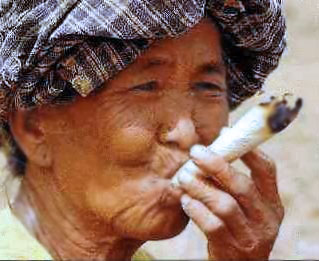
 

fumer le tabac


Throughout the second half of the seventeenth century, tobacco, which until then was in powdered form and was snuffed, became smoking tobacco. As a result, tobacco consumption and the production of pipes increased considerably.

In the nineteenth century things started to speed up for pipe smokers. General Lassalle declared that “a hussar that does not smoke is a bad soldier!”. Following the advice of his General, Napoleon arranged for the creation of a tobacco pipe that would be specifically designed for soldiers in combat. According to history, during the Crimea War (1853-1856), Corporal Bouffard, the head of a regiment of soldiers, lost both of his arms due to canon ball fire during the Siege of Sevastopol. In one of his hands he was still holding his pipe. It is he who gave the name ‘bouffarde’ to the pipe, which it is still known as in France today.
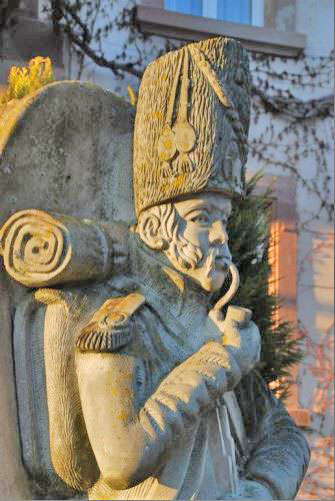
bouffarde


During this period, in the mid-nineteenth century France saw its first industrial factories for pipe manufacturing. Heather was discovered for the fabrication of tobacco pipes in 1856, and great manufacturers like Butz-Choquin and Chacom made Saint Claude, a small village close to Jura, a renowned place for pipes. Pipes from Saint Claude are internationally recognized for being made in the world capital of tobacco pipe.

During the twentieth century, the pipe was officially entered into the army and became something of a symbol, a trademark of WWI French soldiers and British officers. In these periods of conflict, French expressions ‘Aller au casse-pipe’ (literally, ‘to go to the broken pipe’, meaning ‘to go to war’) and ‘casser sa pipe’ (‘to break his pipe’, meaning to die) came into use. The pipe then became an accessory for philosophers, writers, and thinkers in general. Jean-Paul Sartre, Bourbil, Georges Brassens, Jacques Audiard, Lino Ventura, Jacques-Yves Cousteau, and plenty of others… were all pipe smokers.

How did glass blowing start?

The History of Glass Blowing

Glassblowing is a glass-forming technique which was invented by the Syrian craftsman in the 1st century BC somewhere along the Syro-Palestinian coast. The establishment of the Roman Empire provided motivation and dominance of glass production by this method, the use of blown glass for everyday tasks spread. The Phoenicians set up the first glass workshops on the eastern borders of the Empire, in the birthplace of glassblowing in contemporary Lebanon, Israel and Palestine, as well as in the province of Cyprus. Meanwhile, the glassblowing technique also reached Egypt.

By the middle Ages, Venice had become a major center of glassmaking. Then, the glass blowing industry moved to the island of Murano. The Venetian glassmakers from Murano produced cristallo, clear, fine glassware by employing glassblowing, in particular, the mold-blowing technique.

Eventually, this art spread in many parts of the world, in China, Japan and the Islamic lands and became ubiquitous.

In the 1820s the industry experienced the most important innovation since the Syrians invented the blow pipe. Bakewell patented a process of mechanically pressing hot glass which would change how glass was used forever.

After 1890, glass uses and manufacturing developments increased very rapidly.

In 1903, Michael Owens engineered the first automatic bottle blowing machine that could produce millions of light bulbs a day and in the late 1950’s Sir Alastair Pilkington invented float glass production method by which 90% of flat glass is still manufactured today.

Glassblowing involves inflating molten glass into a bubble, or parison, with the aid of a blowpipe, or blow tube. Glassblower, glassmith or gaffer is a person who blows glass. Glassblowing involves three furnaces. The major tools involved are the blowpipe (or blow tube), the punty (or pontil), bench, marver, blocks, jacks, paddles, tweezers, paper and a variety of shears.

A full range of glassblowing techniques was developed within decades of its invention. Before the invention of the metal blowpipes, the ancient glassworkers made clay blowpipes, also known as mouth blowers, due to the accessibility and availability of the resources. Two major methods of glassblowing are free-blowing and mold-blowing. Free-blowing technique held very important position in glassforming ever since its introduction in the middle of the 1st century BC until the late 19th century and is still widely use nowadays. The Portland Vase which is a cameo manufactured during the Roman period is an outstanding example of this method. Mold-blowing was an alternate glassblowing technique that came after the invention of the free-blowing. This tools and techniques have changed very little over the centuries.

The glassblowing craft was passed from father to son or from master to apprentice. From its beginning, the formulas and procedures used in glassmaking were kept as secret and death was the penalty for disclosing secret technique.

The technique of glassblowing has been used for over 2000 years, and over this period, has undergone several transformations in order to manufacture some of the finest artworks that have ever been produced.

How is the coil pot technique done in glassblowing?

See the blog

This is an old school technique a blower uses to make their own tubing. Usually made on a blow tube with a colored stick of glass. Coil Pot by a blower – What you do here is get a blow tube, we usually use a 12mm tube. Flare the end open and then get you some of your favorite colored rod of glass. Heat this rod up and when it becomes hot and malleable you will lay it around the blow tube. You will build this up and it will look like what a potter does with clay when they make a pot. Hence the name coil pot. Once you have this built up you can melt it all together into a bubble and then you can make a tube or whatever you want with it.