Pretty much it is made just like a ratachello but with fume and clear glass.
Sometimes a blower will just use what is called a scalloped tube. the fume the inside and let it collapse, with the ridges making lines.

Pretty much it is made just like a ratachello but with fume and clear glass.
Sometimes a blower will just use what is called a scalloped tube. the fume the inside and let it collapse, with the ridges making lines.
There are many ways to make a joint. Elev8 Premier uses the all in one tool. Then is finalized with a diamond bit to make sure it is perfect.
Joint tools
Just another joint
Any color that the blower wants to turn into a tube can be used. It’s more what should not be used. We really love the cadmium colors as they are rich and when encased in a vac stack or stick stack to be line worked tubing, they are protected from the hot heat of the flame.
Optic molds are used to give glass texture.
Bubble trap can be created from this
Sometimes people will use these for simple millies (mostly soft glass) and is used commonly in soft glass, not so much in boro work
Fuming shows up against dark colors or blacks much better than lighter colors or clear. When you go ahead a fume a dark piece of glass, the effects of the fuming automatically show up. This is for artists who want their piece to show the fuming effects right off the bat, instead of having to get the piece dirty to show the fuming effects. This would be done for any pipe that may not get dirty like a dab rig or pendant.

Fumed on cobalt blue glass
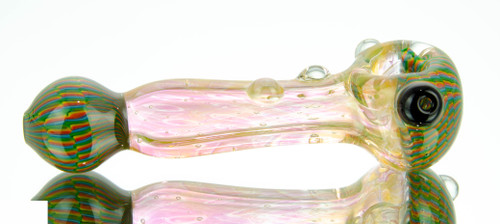
Fumed on clear glass
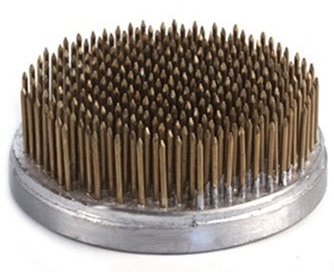
A frog used for bubble trap is the same thing that florists use for flowers.
See our blog for implosion
Slumping glass is a highly technical operation that is subject to many variations, both controlled and uncontrolled. When an item is being slumped in a kiln, the mold over which it is being formed (which can be made of either ceramic, sand or metal) must be coated with a release agent that will stop the molten glass from sticking to the mold. Such release agents, a typical one being boron nitride, give off toxic fumes when they are first heated and must be used in a ventilated area. The glass is cut to the shape of the mold (but slightly larger to allow for shrinkage) and placed on top of it, before the kiln is heated.
This really comes down to what you like best. We find Calibri is one of the best. We also find that butane is butane and use what you like.
A Gilson terp pearl or a Gilson encased terp pearl will both last about the same time. We feel an encased opal may last longer as the opal never gets any oil in it. But we also feel that the opal is compatible with glass, so it will not absorb oils. Really you can get what you like. We have a few standard terp pearls not encased here.